
Iglesia de Nuestra Señora de la Asunción
Heritage
Six hundred years of history in a single building
It wasn't built all at once: it grew over centuries, just like the village itself. It began as a small Mudéjar church, was extended in the 16th century, and was transformed inside in the 18th. Each era left its mark on the walls, and anyone who knows how to read them can trace that history layer by layer.
Highlights
- ·The blind arcade of five arches, on the oldest façade
- ·The bell gable, with a hidden third bell
- ·The granite doorway, with its fan-shaped arch of voussoirs
- ·A dome you can't see from outside
- ·The white plasterwork vaults and the Baroque altarpieces
Outside: a church read in layers
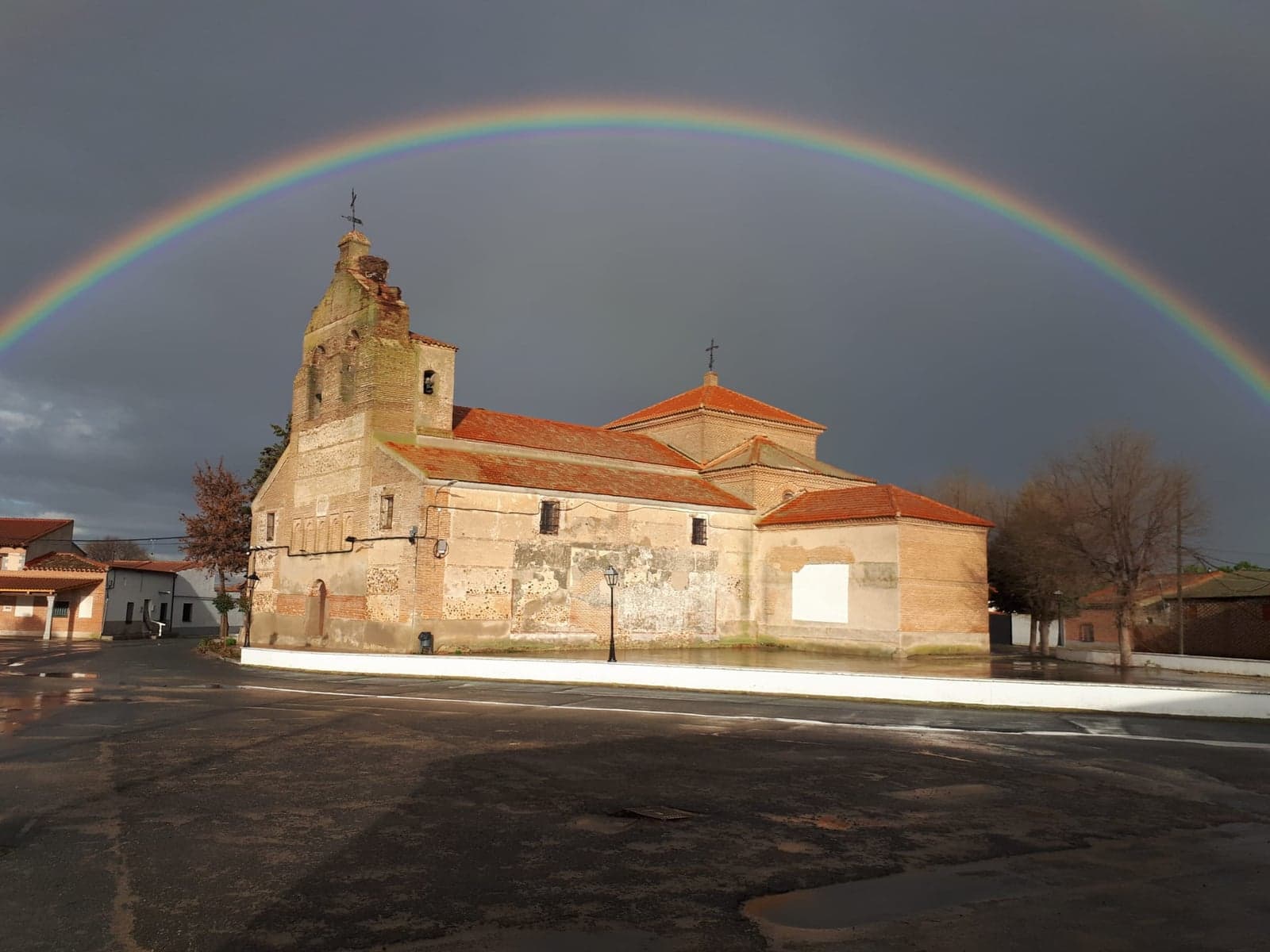
The west façade, where it all began. This is the oldest part, from the Middle Ages, from the time these lands were resettled. On a plain with no quarries, the Mudéjar builders worked with what they had — brick and rubble — and turned it into art. Look for the five blind brick arches, which open onto nothing and exist only to give the wall rhythm, light and shadow. Below, the door through which the village's first residents entered for Mass.
The bell gable. The bell tower of villages that couldn't afford a proper tower. From the square you can see two bells, but walk around the south side and you'll find a third, smaller one. At the top, its usual tenants: the storks.
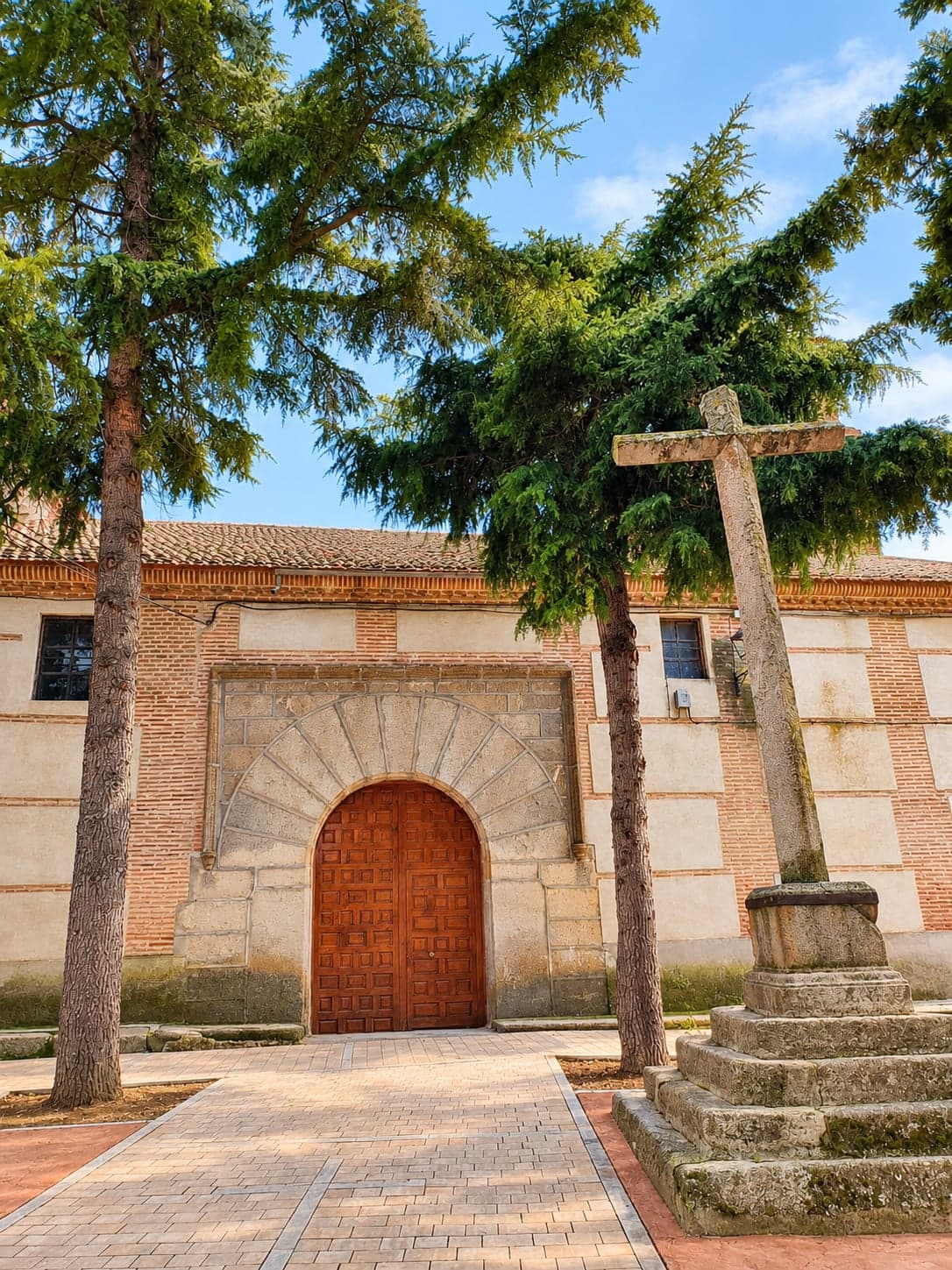
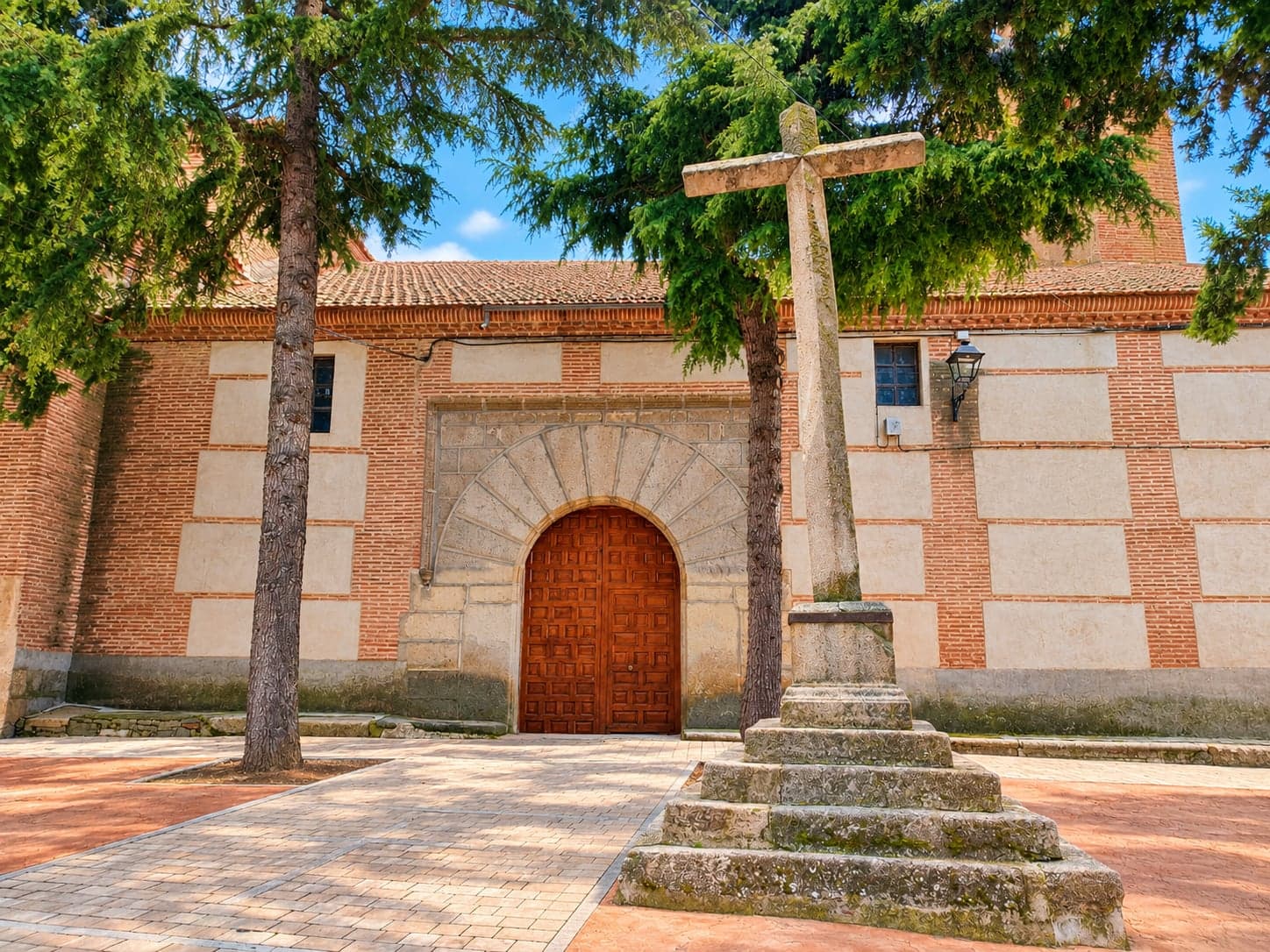
The north doorway. This is how you enter the church today. It dates from the 16th century, between the late Gothic and the Renaissance: an arch of large voussoirs fanning out like rays of sun, framed by a granite alfiz. In a land of mud brick, that carved stone was a luxury — the calling card of the village that paid for it.
The 1679 cross. Facing the doorway, a granite cross bearing its date and the name of the priest who commissioned it.
A hidden dome. The tallest part of the building, a brick box with a four-sided roof, holds the crossing dome inside. You'd never guess it from outside. Inside, it's one of the visit's surprises.
Inside: Baroque splendour
Through the doorway lies a bright, white space, mostly the work of the 18th century.
The vaults. Covered in plasterwork: geometric gypsum designs in relief, layered like lace, that multiply the light.
The main altarpiece. It isn't gilded: it imitates coloured marble. At its centre, the Virgin of the Assumption, the parish's patron, amid clouds and cherubs. On either side, Saint Anthony of Padua and Saint Teresa of Ávila, the great Ávila-born saint.
The side altarpieces. Gilded, with twisted columns covered in vines and clusters of grapes. Between them, a 17th-century Saint Agatha attributed to the school of Gregorio Fernández, the great sculptor of Valladolid, and the Virgin of Mount Carmel, paid for in 1801 by a Carmelite friar born in the village.
Stories held in its walls
For years, the back wall served as the village's handball court (frontón). In 1935, the young people asked the town council for 225 pesetas to repair it; the council, which had no more to give, provided 114. In 1956, residents paid 25,000 of the 34,750 pesetas it cost to repair the roof and floor out of their own pockets. This church wasn't just built — it has been cared for by everyone, together.
Suggested route
Start at the west façade and walk around the south side to see the third bell and the volume that hides the dome. Continue behind the apse and finish on the north side, facing the granite doorway and the cross. You'll have walked through six hundred years in a few steps, and you'll be standing at the door, ready to go in.
Listen to the audio guide at the church's QR codes.
Find Saint James
Saint James the Apostle, patron saint of Cabezas del Pozo, appears three times in this church: at the top of the main altarpiece, in a stained-glass window, and on horseback in his own altarpiece — the image carried in procession every 25 July. Can you find them all?
Timeline
- 12th–13th centuries: first Mudéjar church
- 16th century: extended to three naves, north doorway opened
- 1679: granite cross
- 18th century: new apse, dome, plasterwork and altarpieces
- 1801: altarpiece of the Virgin of Mount Carmel
- Since 2003: restoration of the bell gable
To round off the visit: La Lugareja in Arévalo, the greatest Mudéjar landmark in La Moraña.
Practical information
- Opening hours:
- Mass: Sundays at 11:00. Outside that time, visits by arrangement with the Town Hall.
- Accessibility:
- Ramp access.