
El Pozo Bueno
Heritage
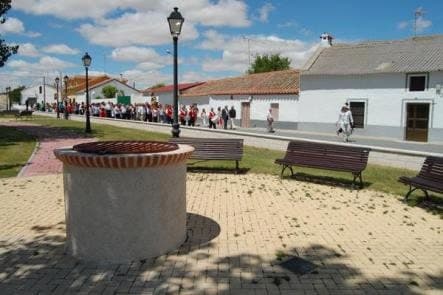
The well that gave a village its name
- What it was
- A Mudéjar brick well, about 5 metres deep, with a granite rim
- Where
- At the entrance to the village, on the old road to Ávila. Today, a new well in the park
- Status
- Disappeared in 1982 by municipal decision; a smaller new well now stands in its place
- Nearby
- La Laguna, right beside the old well, where mules, oxen and sheep used to drink
Stop for a moment here, at the entrance to the village, where the old road to Ávila once began. Today you'll see a small well in the park, but close your eyes and picture another one, much larger: about five metres of Mudéjar brick, topped with a granite rim worn smooth by generations of villagers' hands. It was the Pozo Bueno — the Good Well — and without it, this village wouldn't have a name.
The village's surname
La Moraña was full of villages called Cabezas, and a surname was needed to tell them apart. The villagers chose what they had closest and dearest: their well. As early as around 1200 it appears written as Cabeças del Pozo. Ever since, the name of the village and the name of its well have walked together.
And what about "Cabezas" ("Heads")? Joaquín Ruano records two explanations: the heads of sheep that once grazed these lands, or the heads — the ears — of wheat and barley that turn La Moraña gold every summer.
Life around the well
On flat, dry land, where the rivers run empty in summer, the well was the life of the village. Picture the coming and going of livestock on their way to drink, conversations at dusk while the water was drawn.
Beside the rim were troughs where the mules of the muleteers arriving along the road to Ávila would drink. Water was drawn with a zinc bucket, and nearby stood the inn of "tío Santiaguillo", a stop for travellers passing through. The village's women washed clothes there, and on the stone benches around the well the elders would sit to talk the afternoon away. Its water wasn't good for drinking, but it watered the livestock and kept the village's daily life running.
Looking after it was everyone's job. It's still remembered how "tío Eulalio" and "tío Prudencio" climbed down to the bottom, tied to a rope, to clean it. And old records tell of a small shrine dedicated to the Virgin that once stood beside the well. It meant so much that, when young men were asked where they were from, they answered with pride: "From Cabezas del Pozo."
As Joaquín Ruano, a villager and the village's historian, wrote, «in past times, the life of the village revolved around that well».
The end of the Pozo Bueno
In 1982, by municipal decision, the Pozo Bueno disappeared. For some it had become a danger to children; for others, it was tearing out a piece of the village's history. In 1984, the Diario de Ávila published two articles mourning its loss: in one, the well itself seemed to speak; the other was signed by don Julio Portero, a priest and son of the village.
A work of centuries was lost, but not its memory. The villagers built a new, smaller well on the same spot, so that no one would forget that this is where it all began.
Before moving on, lean over the rim. It may no longer be the same well, but the village still carries its name.